
Managed Firewall Services That Keep Business Moving
Managed Firewall Services That Keep Business Moving
 SecureAX
A firewall alert at 2:13 a.m. is only useful if someone can determine whether it is a failed login attempt, a misconfigured application, or the first sign of a real intrusion. For many growing businesses, that is where managed firewall services become a practical operational safeguard, not simply another security subscription.
A well-managed firewall helps protect internet-facing systems, office networks, cloud workloads, remote users, and business applications. More importantly, it gives the organization a clear owner for the policies, monitoring, maintenance, and response work that too often falls between an internal IT team, a hosting vendor, and a hardware supplier.
What managed firewall services actually take care of
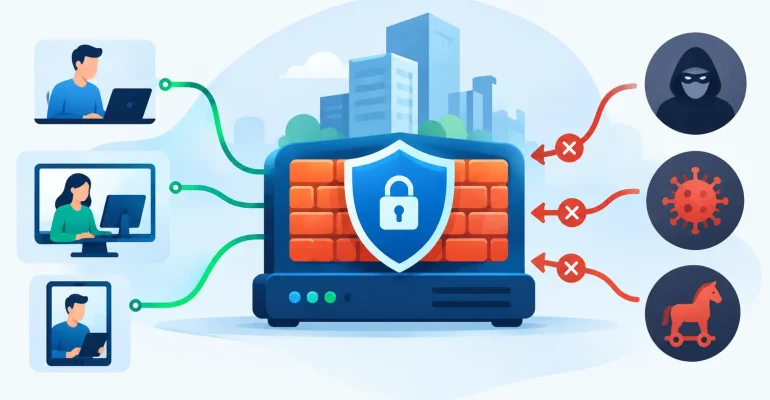
A firewall is a control point. It decides which traffic may enter or leave a network based on security policies. The device or cloud service itself is essential, but purchasing it is only the beginning. Its protection depends on accurate rules, current threat intelligence, timely software updates, and regular review as the business changes.
Managed firewall services place those ongoing responsibilities with a security provider. Depending on the engagement, this can include initial configuration, rule management, firmware updates, log monitoring, alert investigation, vulnerability reduction, reporting, and incident support. The objective is not to block everything. It is to allow legitimate business activity while reducing unnecessary exposure.
For example, a finance team may need secure access to a cloud accounting platform, a retail branch may need reliable connectivity to payment systems, and a regional company may need controlled access between offices and cloud servers. Each requirement creates rules that must be designed carefully. A rule that is too restrictive disrupts work. A rule that is too broad can expose systems that should never be reachable from the internet.
Firewall management is not a one-time project
Network environments change constantly. New staff work remotely, vendors request access, cloud applications are added, websites move to a new server, and legacy services remain active longer than expected. Each change can alter the organization’s attack surface.
Without disciplined management, firewall configurations can accumulate old rules, duplicate objects, open ports with unclear ownership, and temporary exceptions that were never removed. These are common issues, particularly when multiple vendors manage different parts of the environment. Regular review gives the business a chance to remove access that is no longer required and confirm that essential services remain protected.
Why businesses struggle to manage firewalls internally
Small and mid-sized organizations often have capable IT staff, but their time is divided across employee support, Microsoft 365 administration, office moves, laptops, backups, servers, cloud services, and urgent business requests. Firewall logs and rule reviews can become a lower priority until an outage or security incident forces attention.
This is not a failure of internal IT. It is a capacity problem. Effective firewall management requires specialized familiarity with network traffic, threat patterns, vendor platforms, and the business applications that depend on connectivity. It also requires someone to be available when unusual activity appears outside normal business hours.
The cost of overlooking firewall administration is not limited to a cyberattack. An unmanaged change can interrupt VPN access, prevent an application from reaching its database, or block a branch from communicating with a central system. When several providers are involved, troubleshooting can turn into a series of handoffs. The business is left waiting while each vendor argues that the problem sits elsewhere.
A managed service creates clearer accountability. The provider should understand the firewall configuration, document approved changes, investigate alerts, and work with the relevant cloud, hosting, or connectivity parties when a problem crosses service boundaries.
What a dependable managed firewall service should include
The exact scope should match the organization’s environment and risk profile. A company with one office and cloud-based applications needs a different service from a business operating warehouses, branches, servers, and regional VPN connections. Still, a dependable service should address the following core areas:
- Secure deployment and policy design: The firewall should be configured around known applications, network segments, remote-access requirements, and approved traffic flows rather than broad allow rules.
- Continuous monitoring and alert triage: Security events need context. Repeated blocked scans may be routine internet noise, while unusual outbound traffic or repeated privileged login attempts may require immediate investigation.
- Patching and platform maintenance: Firewall firmware, security signatures, and supporting components must be kept current under a controlled process that considers compatibility and potential downtime.
- Rule and access management: Changes should be requested, approved, documented, and reviewed. Temporary access for a vendor or project should have an expiry date wherever possible.
- Reporting and service accountability: Business and IT leaders need clear reporting on significant alerts, changes made, exposure identified, and recommended improvements.
These elements matter because a firewall can fail quietly. It may continue passing traffic while a risky rule remains open, logging is incomplete, or an alert is never investigated. Visibility, documentation, and response discipline turn a firewall from a passive device into an active security control.
Managed firewall services work best with layered security
A firewall is powerful, but it is not a complete cybersecurity program. It cannot prevent every phishing email, secure an unmanaged laptop, correct weak passwords, or restore data after a destructive event. Businesses should treat it as one layer in a coordinated defense.
Endpoint protection helps detect threats that reach user devices. Multi-factor authentication reduces the risk of compromised credentials. Secure email controls reduce phishing exposure. Backups and disaster recovery provide a recovery path if systems are encrypted, deleted, or disrupted. Vulnerability assessments identify weaknesses that may exist behind the firewall.
This is why an integrated provider can be valuable. When firewall management, endpoint protection, cloud infrastructure, backups, and responsive IT support are managed with shared visibility, incident response is usually faster and less fragmented. SecureAX supports this model by combining security management with cloud, hosting, backup, and operational IT services under accountable support.
That said, integration should not mean accepting a vague scope. Businesses should know exactly what the provider monitors, who contacts whom during an incident, how after-hours escalation works, and which services remain the responsibility of internal staff or other vendors.
Questions to ask before selecting a provider
The best provider is not necessarily the one promising the most features. It is the one that can explain how its service applies to your environment and demonstrate a reliable support process. Ask how alerts are triaged, what qualifies as a security incident, and how quickly the team responds at different severity levels.
Also ask whether the provider performs regular policy reviews or only reacts to tickets. Reactive support may be adequate for a simple, stable network, but businesses with changing cloud systems, remote access, or multiple locations usually benefit from proactive review. Confirm how configuration backups are handled and whether changes are documented in a way your organization can retain if staff or vendors change.
Technical depth matters as well. The provider should be comfortable working across office networks, VPNs, public cloud environments, hosted servers, and business applications. A firewall issue rarely stays within one box. The ability to trace a problem across the network, cloud platform, DNS, endpoint, and application layers can reduce downtime considerably.
Finally, look for commercial clarity. A low monthly fee may exclude after-hours support, emergency changes, firewall replacement, or remediation work after an incident. Predictable costs are valuable, but only when the service scope reflects the business risk being managed.
Start with the risks that could stop your operations
The right starting point is not a product comparison. It is a short review of what must remain available: customer-facing websites, email, ERP or accounting access, remote connections, payment systems, cloud servers, and inter-office communications. Identify who uses each service, where it is hosted, and what traffic it requires.
From there, a provider can help build a firewall policy that is deliberate rather than inherited from years of ad hoc changes. The result should be practical security: fewer unnecessary openings, better visibility when something unusual happens, and a team that knows how your business is connected before an urgent incident occurs.
Security becomes easier to manage when responsibility is clear. A firewall should not be the system everyone assumes someone else is watching. It should be a maintained, monitored part of the business foundation that lets your people work with greater confidence.